TL;DR
I trained a family of small language models (1.8M–56.6M non-embedding params) from scratch on TinyStories, on Kaggle’s free T4 GPU, with no high-level modelling libraries. Running controlled experiments, I found:
- Most “standard” training tricks are no-ops at this scale. Warmup length and LayerNorm-vs-RMSNorm made no measurable difference to final loss. The one lever that mattered was peak learning rate — the textbook default was simply too conservative.
- A clean scaling law that turned out to be a trap. Loss followed a tidy power law with an apparent floor at ~1.16 — but doubling the compute budget on the largest model punched straight through it. The floor was compute-limited, not a data ceiling. Lesson: don’t read an irreducible floor off an undertrained sweep.
- A tiny model rediscovers big-model circuits. Visualizing attention, the 1.8M model had crisp previous-token heads and attention sinks — the same interpretable structures documented in GPT-scale models.
- Specialization beats scale on-distribution. Judged by an LLM on story quality, my 56.6M model beat GPT-2 (124M) at the children’s-story task, because GPT-2 — though a stronger language model — can’t stay in the genre.
Full code and lab notebook: github.com/rishipadhye/my-LLM.
Why build this
I wanted to actually understand transformers, not import one. So everything — the BPE tokenizer, multi-head attention, the training loop with AMP and cosine scheduling, checkpointing — is hand-written. The goal was never a state-of-the-art model; it was to run controlled experiments on a system small enough to iterate on in an hour, and to see how much of the received wisdom from GPT-scale training actually transfers to the tiny regime.
The base model: a ~30M-parameter decoder-only transformer (512-wide, 8 layers, 8 heads, 8k-token vocab), trained on TinyStories to val loss 1.401. It writes fluent, coherent little stories. That was the starting point, not the point.
Finding 1 — Most training tricks do nothing here
I ran three ablations expecting to learn which knobs matter. The answer, three times running, was “not this one”:
| Ablation | Result |
|---|---|
| LayerNorm vs RMSNorm | Loss tie (1.601 vs 1.603); LayerNorm ~33% faster (fused kernel) |
| Warmup length (50 / 500 / 2000) | Null (1.590 / 1.599 / 1.601) — within noise |
| Warmup under stress (10× LR, no clipping) | Still null; neither run diverged |
The warmup result surprised me most. I removed gradient clipping and cranked the LR 10× specifically to make warmup matter — and it still didn’t. The reason is the optimizer: AdamW already normalizes each parameter’s update by a running estimate of its own gradient magnitude. That adaptive step-sizing does the very job warmup and clipping were invented for, so at this scale they’re redundant. A “null result,” but a mechanistic one — and a reminder that a lot of training folklore is really “things that matter for plain SGD at billion-parameter scale.”
Finding 2 — Learning rate was the only real lever
After three ties, the LR sweep was the first experiment to actually show a difference:
| Peak LR | val loss |
|---|---|
| 3e-4 (the default I started with) | 1.601 |
| 1e-3 | 1.559 |
| 3e-3 | 1.557 |
Tripling the LR cut loss by 0.042 — ~20× the run-to-run noise floor — then plateaued. My original 3e-4 baseline was just too timid. Promoting 1e-3 to the full 80k-step run carried the gain all the way through (1.43 → 1.401). The takeaway I’ll keep: tune the learning rate before touching architecture.
Finding 3 — A scaling law, and the floor that wasn’t
I trained a 5-point ladder (1.8M → 56.6M non-embedding params) at a fixed token budget and fit loss against parameters. It’s a clean, gently bending power law:
L ≈ 1.16 + 0.78 · N^−0.276 (R² = 0.9975)
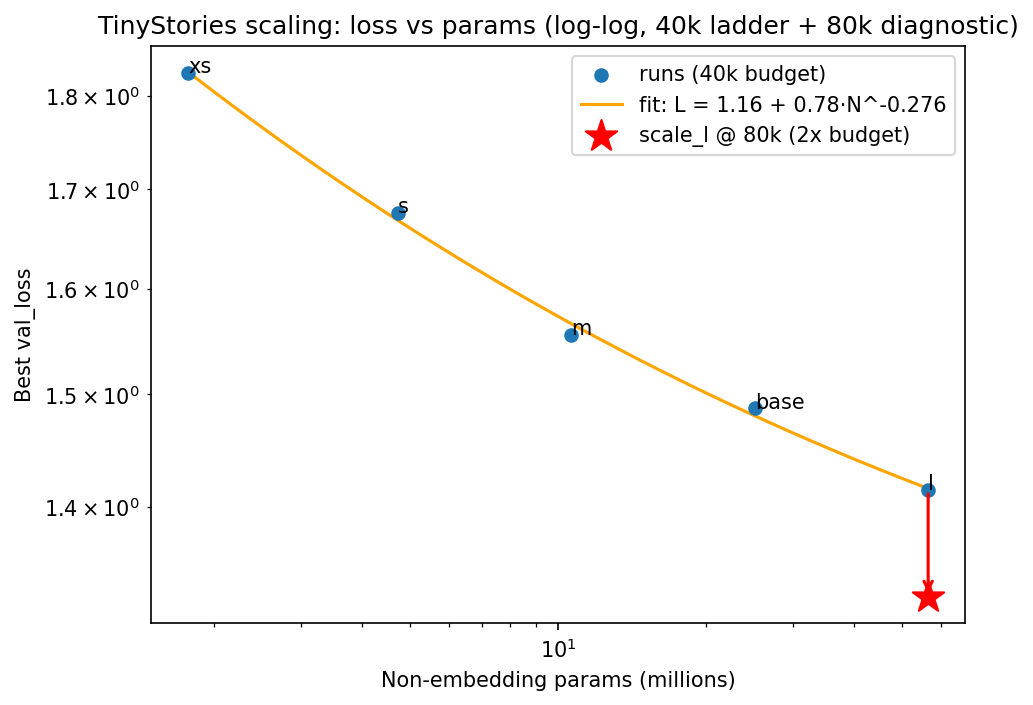
The bend toward ~1.16 looked exactly like an irreducible loss floor — the point where more parameters stop helping. It’s tempting to stop there and write “TinyStories saturates at 1.16.”
So I tested it. I retrained the largest model for double the budget. If 1.16 were a real data ceiling, more compute shouldn’t help. Instead loss dropped from 1.415 to 1.325 — straight through the “floor,” and past even the fully-trained 30M reference. The floor was an artifact of the training budget, not the data. The real lesson generalizes well beyond this project: a scaling curve fit to undertrained points will show you a floor that isn’t there. That single control run changed the conclusion — which is exactly why I ran it.
Finding 4 — A tiny model rediscovers GPT’s circuits
Loss curves say how well a model does, not what it learned. I added a one-line hook to capture attention weights and plotted them. Even the smallest model (1.8M params, 4 layers) had learned recognizable, interpretable structure:
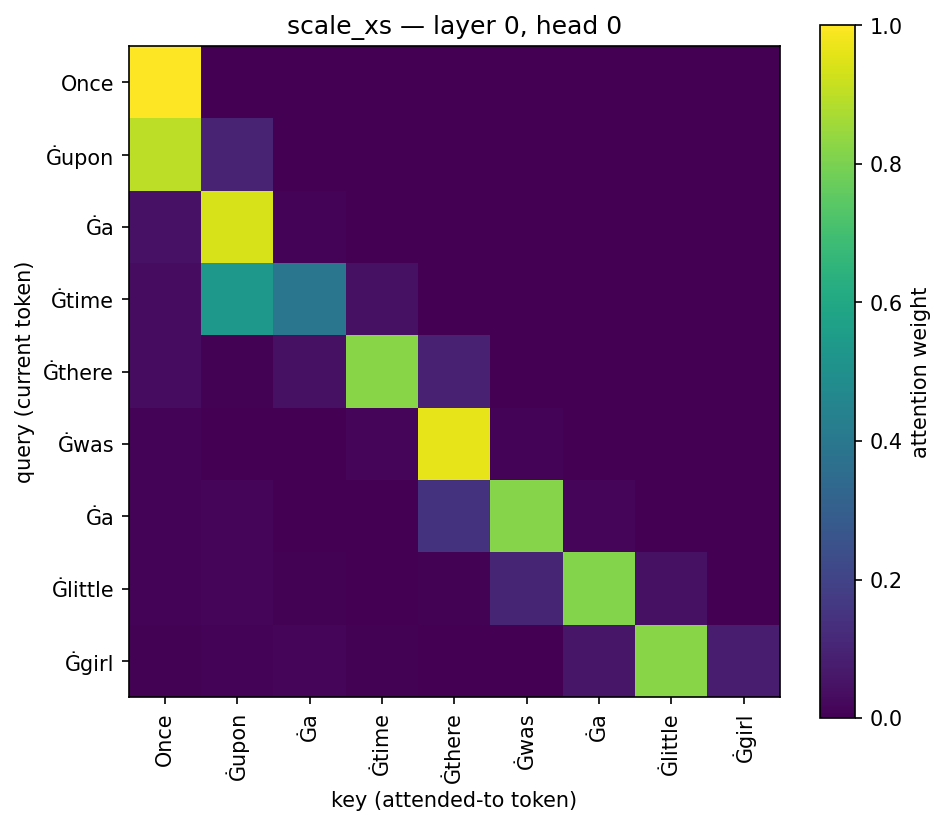
That bright sub-diagonal is a previous-token head — every token attending to the one before it. Plotting all heads revealed a familiar taxonomy: previous-token heads, attend-to-self heads, and attention-sink heads (nearly every token dumping attention onto the first token) — the same circuits documented in GPT-scale interpretability work, reinvented by a model trained only on children’s stories.
I also probed for induction heads (the copy/pattern-completion circuit) by scoring every head on a repeated prompt. Both model sizes showed only a weak, above-chance induction bias (top head ~2× chance) — no dedicated induction circuit at either scale. That’s an honest negative: TinyStories rarely rewards long-range verbatim copying, so there’s little pressure to build one.
Finding 5 — Specialization beats scale, on-distribution
Finally: are the stories any good? I had every model continue 10 prompts, and scored the continuations 1–5 on six dimensions with an LLM judge (Llama-3.3-70B), instructed to grade fitness for a young child’s story.
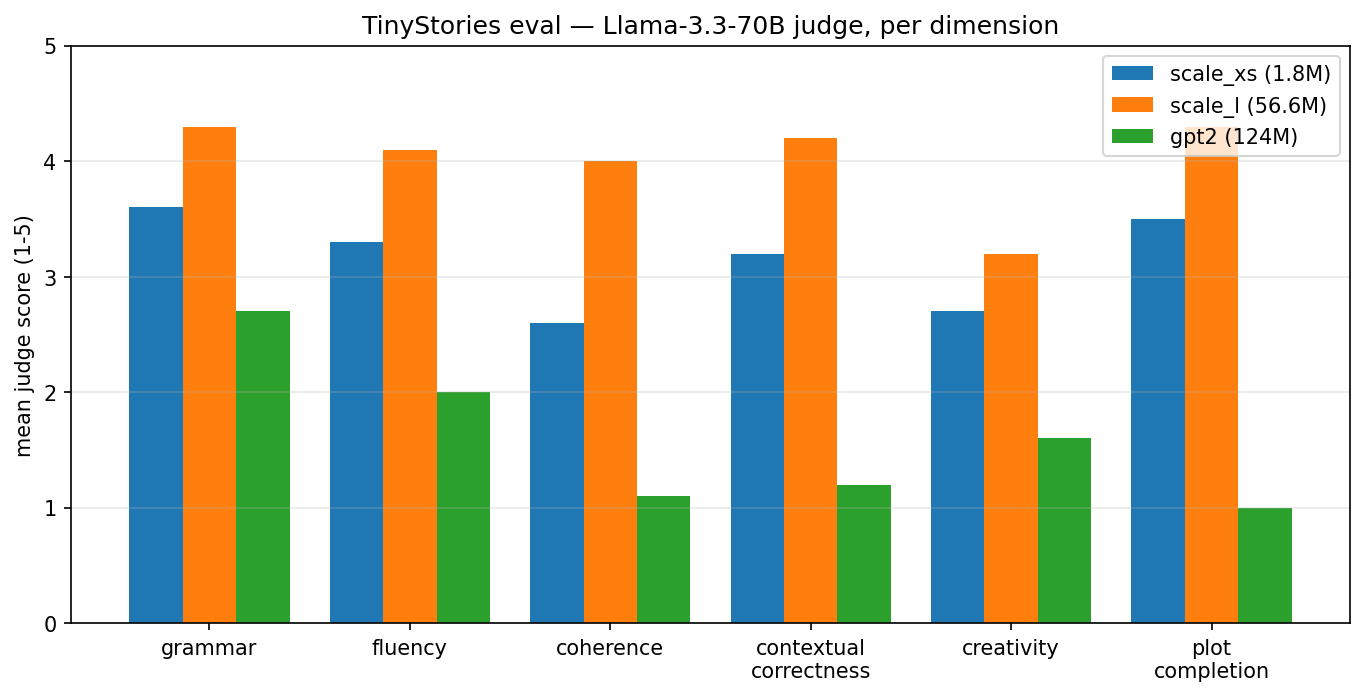
My 56.6M model (overall 4.02) beat GPT-2 (124M, overall 1.60) — a general model twice its size — at the children’s-story task. GPT-2 collapses on the story dimensions (coherence, staying on-prompt, plot) because it drifts off-genre into police stations and inconsistent characters. A model specialized for a narrow distribution beats a bigger general one at that distribution.
An honest caveat, because it matters: GPT-2’s low grammar/fluency scores almost certainly understate its real linguistic quality — my task-framed judge let the genre-drift bleed into the language scores (a halo effect). The defensible claim is narrower: GPT-2’s weakness here is task-fit, not language. Flagging where my own evaluation is soft is part of doing it honestly.
What I’d do differently
- Compute-optimal points. The scaling ladder is near-converged, not Chinchilla-optimal — fine for showing the shape, not for a precise exponent.
- A more rigorous eval. One generation per prompt, ten prompts, a single judge. Multiple samples, more prompts, and multiple judges would tighten it.
- A fairer prompt for GPT-2. I fed GPT-2 the same bare story-starters my model saw, but GPT-2 was never told it was writing for young children — so some of its genre-drift is a prompting artifact, not a capability gap. A system/instruction prefix (“Write a simple children’s story:”) would give it a fair shot at staying on-genre and make the comparison cleaner.
- A dedicated induction probe. Averaging over many random repeated sequences would turn the weak induction signal into a firm result either way.
Takeaways
The thread running through all of it: at 30M parameters, most of what people tune is noise, and the things that actually move the needle are unglamorous — the learning rate, the training budget, and the match between model and data. The most valuable habit this project reinforced wasn’t any single result; it was running the control that could disprove the tidy story — the 80k diagnostic that killed the “data floor,” the caveat that keeps the eval honest.
Built with PyTorch on a single Kaggle T4. Code, configs, and the full lab notebook (every experiment, including the null results): github.com/rishipadhye/my-LLM.
]]>